Issue No. 03 | October 2026 (covering mid-August – end-October 2026)
A regular update on the cross-border legal, regulatory, and commercial developments that matter to life sciences and healthcare companies, investors, and their advisers — across the Chinese mainland, Hong Kong SAR, the US, and the EU.
In this issue
- US Treasury proposes to prohibit US investment in Chinese biotechnology: a cash-paid licence stays outside, but a licence paid in equity through a NewCo may be caught as a joint venture.
- The Chinese mainland now requires registration before any of 40 listed technologies is exported, and has proposed banning the export of cell and gene therapy and siRNA platforms.
- NDRC’s new outbound investment rules, in force from 1 December, 2026, require advance reporting of every investment made through an overseas subsidiary, whatever its size, and treat a foreign party’s demand for technology or data as a reportable event.
- The Order 818 filing track has turned from regularizing old studies to admitting new ones; no clinical translation has yet been approved
- The UFLPA Entity List has reached genetic testing for the first time, with three genomics and sequencing companies added on 29 October.
- Outside China, the EU pharmaceutical package is close to final adoption, the FDA has restated that geography does not change the evidence bar, and the BIOSECURE list is due by 18 December.
Headlines
1. US Treasury proposes to prohibit US investment in Chinese biotechnology: a cash-paid licence stays outside, but a licence paid in equity through a NewCo may be caught as a joint venture
Status: Proposed rule, not in force — United States — Treasury notice of proposed rulemaking, 31 CFR Part 851, issued 22 October 2026 and published 26 October 2026 (91 FR 67396); comments due 7 December 2026
When Congress enacted the COINS Act in December 2025 as part of the FY2026 National Defense Authorization Act, it put the US outbound investment program on a statutory footing as a new Title VIII of the Defense Production Act. Treasury’s proposed implementing rule, a new 31 CFR Part 851 issued on 22 October, uses that authority to add biotechnology to the program for the first time. It places biotech only in the prohibited tier, so there is no category of biotech deal that would merely need to be notified. The proposal is not yet law: the current rule, Part 850, which does not cover biotech, applies until Part 851 is finalised and takes effect, and the statute gives Treasury until 13 March 2027 to issue the regulations.
The prohibited biotechnology centres on using a biological system to develop or produce pharmaceutical compounds, listed as including small molecules, vaccines, cell and gene therapies and monoclonal antibodies, and extends to brain-computer interfaces, biomanufacturing equipment, sequencing and laboratory automation. Because the trigger is the link to a biological system rather than the type of molecule, recombinant biologics fall clearly within it, whereas chemically synthesised small molecules are caught only on a broad reading of “use of a biological system”. Treasury has itself asked whether the scope should be narrowed to advanced or frontier technologies.
A licence paid for with upfront, milestone and royalty payments is not a covered transaction, but the proposal reaches structures built around a licence in three ways.Treasury reads joint venture in its plain-English sense, as the contribution of capital and/or assets by two parties and the sharing of profits and losses, and does not require a new entity. A NewCo in which a Chinese originator contributes an asset for equity alongside US investors therefore fits those words on their face. Because technology-transfer contracts are excluded from the exception for arrangements secondary to a covered transaction, a licence that travels with an equity investment cannot be treated as a separate ancillary contract. And because principal place of business now includes the place where an entity conducts its main business activities, an offshore company whose management or core R&D sits in China can be a covered foreign person whatever its cap table shows.
Enforcement under the current rule has already begun, with Treasury’s first Part 850 penalty, of $200,000, announced on 7 October for an unnotified AI investment of about $92,000 by a US company’s controlled fund in China. On 24 October MOFCOM called the proposal “a textbook case of over-generalized national security measures” and said China“reserves the right to take corresponding measures”.
Why it matters: For investors, the analysis now has two separate parts. Whether the target is a covered foreign person turns on facts that diligence can establish, namely aggregate Chinese ownership, control, and where the company is headquartered, managed and does its main work, and a stake below 50 percent answers only the first of these. Whether the investment is a joint venture with a Chinese party turns instead on the structure of the deal itself, and the proposed rule offers no safe harbour or ownership threshold for it. A structure in which a Chinese party contributes assets for equity alongside US cash should therefore be planned on the basis that the prohibition applies, unless the final rule says otherwise. For Chinese companies raising US capital, this means that where management and R&D actually sit now matters as much as who owns the shares. The rule applies only from the final rule’s effective date, and investments made afterwards under binding, uncalled commitments entered into beforehand are excepted, so transactions being agreed now still have room to be structured.
Source: Treasury notice of proposed rulemaking, 31 CFR Part 851 (91 FR 67396, 2026-10-26); P.L. 119-60, div. H, §8521 (50 U.S.C. 4581–4589); Treasury penalty announcement (2026-10-07); MOFCOM spokesperson remarks (2026-10-24); as of 2026-10-29.
2. The Chinese mainland now requires registration before 40 listed technologies are exported, and has proposed export bans on cell and gene therapy and siRNA platforms
Status: Registration in force since 16 October 2026; catalogue revision in draft, comments due 15 November 2026 — the Chinese mainland — MOFCOM and MOST Announcement No. 48 of 2026
On 16 October MOFCOM and MOST published a draft revision of the Catalogue of Technologies Prohibited or Restricted from Export covering 40 technologies in AI, biomedicine and photovoltaics, five of them biomedical. Three would be prohibited: proprietary cell and gene therapy technology-process platforms, proprietary siRNA technology-process platforms, and the artificial genetic modification and directed passaging of pathogens to enhance their function. The other two, proprietary technology for the universal discovery and validation of novel targets for cell and gene therapy and for siRNA, would be restricted, while antibodies and small molecules, rumoured in May to be candidates, do not appear. For the two platform entries the prohibition is confined to transfer of ownership abroad, so licensing out, outsourced R&D and manufacturing services, and the process technology a specific product needs for its business development all remain outside it. For the restricted entries, licensing out would qualify for automatic licensing, which eases the licence process but does not remove the need for a licence.
What already binds companies is a registration duty that took effect on publication. Until the revised catalogue takes effect, an exporter must register on MOFCOM’s online platform before exporting any annex-listed technology, whether by transferring ownership abroad, licensing it for use abroad, or a change of its owner or actual controller to an offshore party. The duty also reaches exports “that have already begun but are not yet complete”. The filing discloses the parties, destination, intended use and expected value of the transaction; exporters judge for themselves whether they are in scope, and the announcement states no penalty for failing to register. The Technology Import and Export Administration Regulations themselves are listed only for preparatory revision in the State Council’s 2026 legislative plan, so a revision of the licensing regime does not appear imminent.
Why it matters: The proposed prohibition is therefore an ownership rule: it leaves single-asset and platform licensing and CRO or CDMO services alone, and catches the sale of a platform, its contribution to an offshore company and the assignment of platform IP abroad. The registration duty is different: it applies only to annex-listed technology but covers licensing and changes of control as well as transfers of ownership. What counts is the technology that leaves China, so a licence limited to a product carries that product rather than the platform used to make it. Companies with transfers already under way should decide now whether they need to register, bearing in mind that the filing brings the transaction to MOFCOM's attention. Comments on the draft close on 15 November; the timing for the revised catalogue to take effect is uncertain, and the registration duty continues until it does.
Source: MOFCOM and MOST Announcement No. 48 of 2026 and annexes (2026-10-16); MOFCOM spokesperson Q&A (2026-10-16); State Council 2026 legislative work plan, Guo Ban Fa [2026] No. 14; as of 2026-10-29.
3. NDRC’s new outbound investment rules, in force from 1 December, 2026, require advance reporting of every investment made through an overseas subsidiary, whatever its size, and treat a foreign party’s demand for technology or data as a reportable event.
Status: Promulgated, effective 1 December 2026 — the Chinese mainland — NDRC Order No. 49, Measures for the Administration of Outbound Investment (adopted 15 October 2026, promulgated 16 October 2026, released 22 October 2026); repeals NDRC Order No. 11 of 2017
NDRC’s final Measures replace its 2017 rules on outbound investment and are among the first implementing rules issued under the State Council's Regulation on Outbound Investment (Order No. 837), a comprehensive administrative regulation in force since 1 July 2026 covering outbound investment management and services generally, with outbound security review as one of its provisions (Article 15). The most significant practical change is to reporting. Under the 2017 rules, a Chinese investor that invested through a controlled overseas entity had to report only large non-sensitive projects of US$300 million or more (Order 11, Article 42). Order 49 removes that threshold, so every non-sensitive investment made through a controlled overseas entity, including round-trip investment back into China, now needs an overseas reinvestment report filed 10 working days before the investment is made (Article 14). Reported investments must also be closed out with a completion or termination report (Article 42), and a financial institution that settles, finances or guarantees an unreported investment can be referred by NDRC to its regulator (Article 66). Investments of US$100 million or more, or that bear on China's foreign relations, need a further report before the investment agreement is signed (Article 41).
Other parts of the Measures change less. The security review is still a one-line cross-reference, with Article 15 requiring investments that affect national security to be reviewed as required but no procedure yet published, and biotechnology is named nowhere in the 76 articles. Article 53, however, adds a duty that may matter to collaborations: an investor must report as a major adverse situation any case in which a foreign party demands technology, data or the like to an extent that threatens or harms China's national interests or national security.
Why it matters: For Chinese groups with offshore holding structures, the change on 1 December is less about approval than about advance notice. Steps that previously needed nothing below US$300 million, such as a Hong Kong subsidiary taking equity in an offshore NewCo, funding an affiliate abroad or investing back into China, will each need a report 10 working days ahead. Because banks that handle an unreported investment can be referred to their regulators, they have reason to ask to see it, and financing timetables should allow for that lead time. Article 53 is the provision most likely to reach existing contracts, since information, technology-access and data-sharing rights that a foreign partner can invoke could become the trigger, and it is better to identify them before they are used.
Source: NDRC Order No. 49 (promulgated 2026-10-16, released 2026-10-22) and NDRC Q&A; NDRC Order No. 11 of 2017, Article 42; State Council Order No. 837; as of 2026-10-29.
4. The Order 818 filing track has turned from regularizing old studies to admitting new ones; no clinical translation has yet been approved
Status: In force — the Chinese mainland — Order 818 filing lists, batches 7–14 (10 September to 27 October 2026)
As mentioned in Issue 02, almost all of the first 93 studies filed under State Council Order 818 were existing studies being re-filed from the earlier stem-cell and somatic-cell regimes. That has now reversed. After a month without a new list, eight further batches were published between 10 September and 27 October at roughly one a week, adding 64 studies for a total of 157. Only nine of the 64 carry the footnote marking a prior filing. Half of the new filings name a company rather than a hospital as the sponsoring institution. Stem-cell and immune-cell studies still predominate, but the list now also includes gene-modified stem cells, personalised mRNA and neoantigen cancer vaccines, iPSC-derived cell therapies and two neural-interface studies. A filing allows a clinical study to proceed but is not an approval, and no application for clinical translation has yet been approved.On the drug side, CDE released for comment on 19 August a draft acceleration programme for cell and gene therapy products, the Xianrui pilot, which would give up to 15 products a year support across the whole review process; it has not yet been finalised.
Why it matters: For developers of cell, gene, mRNA and neural-interface technologies, the track has become a working, roughly weekly route to first-in-human data in China outside the IND system, and companies are using it directly as sponsors. It remains a route to registered research rather than to a marketable product, however. No study has yet been approved for clinical translation, and no published text explains how data generated under Order 818 could later support an NMPA registration, so the choice between the two tracks is worth making deliberately at the outset.
Source: CNCBD filing lists, batches 7–14, and project-information annexes (cncbd.org.cn, 2026-09-10 to 2026-10-27); CDE notice on the “Xianrui” pilot draft (2026-08-19); as of 2026-10-29.
5. The UFLPA Entity List now reaches genetic testing, with three genomics and sequencing companies added on 29 October
Status: In force — United States — DHS Federal Register notice, 91 FR 68159, published 29 October 2026
DHS has added three companies from one Chinese genomics group to the UFLPA Entity List, citing genetic-testing work carried out in Xinjiang with the regional government; these are the first listings directed at genetic testing rather than at manufacturing inputs. Goods from listed entities are presumed to be made with forced labour and are refused entry to the US unless the presumption is rebutted. Because the same companies already appear on the Department of War’s 1260H list, which feeds the BIOSECURE list due in December, import restrictions and federal procurement restrictions are now converging on them. MOFCOM said on 29 October that China will take the necessary measures.
Why it matters: Laboratories, CROs and diagnostics companies that rely on these companies’ sequencing instruments, reagents or services should review their US-facing supply chains. Taken together with Treasury’s proposal to treat sequencing as a prohibited technology for investment, the US is now addressing sequencing through imports, federal procurement and outbound capital at the same time.
Source: DHS notice, 91 FR 68159 (2026-10-29); MOFCOM spokesperson remarks (2026-10-29); as of 2026-10-29.
6. Outside China, the EU pharmaceutical package is close to final adoption, the FDA has restated that geography does not change the evidence bar, and the BIOSECURE list is due by 18 December.
Status: Legislative procedure (EU); agency statement (US); statutory deadline (US)
In the EU, the Council adopted its first-reading position on 28 September and published it on 1 October. The file went to the European Parliament for second reading on 8 October, with a plenary vote indicated for 23 November. If Parliament approves the Council’s position, or takes no decision within three months (extendable by one), the package is deemed adopted. It keeps the architecture described in Issue 02: eight years of data protection plus one year of market protection, conditional extensions capped at eleven years and a transferable exclusivity voucher for priority antimicrobials. It will apply only after publication and transitional periods, however, so Directive 2001/83/EC and Regulation 726/2004 remain the law for now.
In the US, FDA’s centre directors wrote on 2 September that geography does not change the evidentiary requirements for clinical data and signalled more inspections of foreign clinical sites. That is a statement of practice, not a new rule. OMB's BIOSECURE list of biotechnology companies of concern is due by 18 December and had not been published as of 29 October; Treasury's proposed outbound rule cross-refers to it.
Why it matters: Companies can now begin modelling EU exclusivity under the new architecture, although filing plans should stay on current law until the transitional dates are known. The FDA statement means that China sites will be judged on GCP compliance and inspectability rather than on location, so the sensible response is to keep foreign sites ready for inspection rather than to exclude them. The BIOSECURE list, once published, will determine which suppliers federal contractors must move away from and will also feed directly into the outbound investment rule.
Source: European Parliament Legislative Observatory, procedure files 2023/0131(COD) and 2023/0132(COD); Article 294 TFEU; FDA Voices (2026-09-02); FY2026 NDAA §851 (BIOSECURE Act); as of 2026-10-29.
Also watching
The Chinese mainland. NHSA said on 20 October that the 2026 reimbursement and commercial-insurance catalogue results were confirmed in September and that agreements are now being signed, with the new catalogues expected in November and, on the annual pattern, taking effect on 1 January 2027. Two measures aimed at clinical development have also taken effect: CDE’s pilot for bringing organoid, organ-chip and other non-animal data into drug review (the Pilot Program, Notice No. 46 of 2026) on 28 September, and NMPA’s revised inspection key points for clinical-trial registration inspections, which apply to trials whose first subject consents on or after 1 September and were followed by CDE guidance on computerised systems and electronic data on 22 September. Provinces will begin implementing the 12th volume-based procurement round from mid-November.
United States. The 100 percent Section 232 duty on patented pharmaceuticals has applied to all remaining importers since 29 September, and BIS procedures issued a week earlier put the zero-rate categories into operation, including cell and gene therapies, orphan-only drugs and a zero-rate line for clinical-trial supply.
What has not moved. As of 29 October, several things the market has been watching had still not happened. Treasury had issued no FAQ on Part 851 and had not extended the comment period, and the BINSA bills (H.R. 9102 and S. 5316), which would bring licensing itself into outbound review, had had no markup. MOFCOM had issued no FAQ or extension on Announcement No. 48, and no company had publicly reported a registration. The Order 837 security review still had no published procedure, and no Order 818 study had been approved for clinical translation. The HGR implementing rules also remain in draft, the Drug Registration Measures (2020) have still not been conformed to the 2026 Implementing Regulations of the Drug Administration Law, and NHSA’s notice on first-launch pricing for new drugs has not been formally issued.
Source: NHSA statement (2026-10-20); CDE Notice No. 46 of 2026; NMPA Center for Drug Inspection release (2026-08-31); CDE guidance (2026-09-22); BIS notice, 91 FR 60360 (2026-09-23); congress.gov / govinfo bill status; MOFCOM announcement page; NDRC Order No. 49; CNCBD notice list; NHC draft HGR Implementing Rules (2026-05-08); as of 2026-10-29.
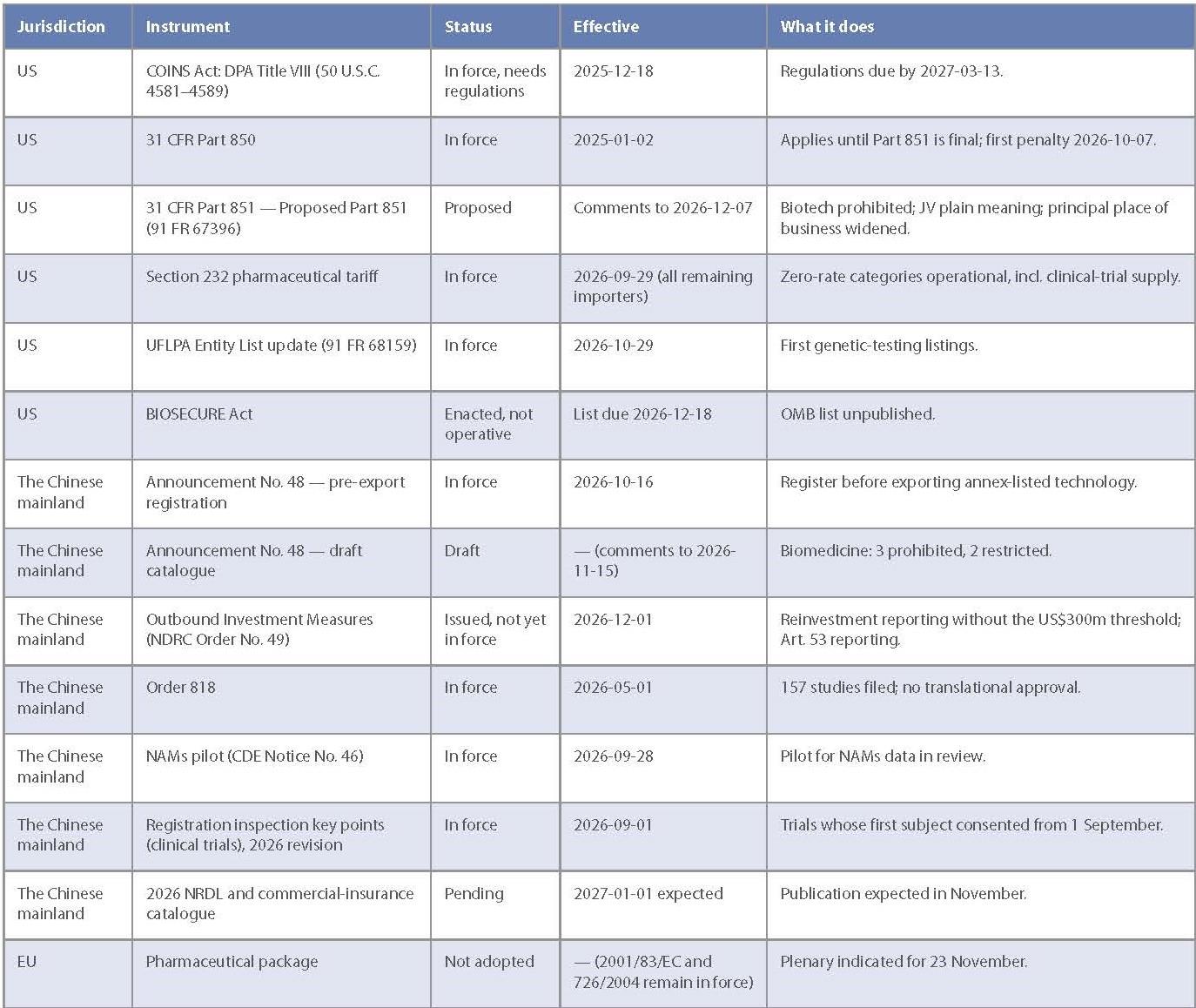
Regulatory tracker
Feature
Two governments, one line: ownership, not the licence, and both have left the edge open
Within a single week in October, Washington and Beijing each published rules that will shape which cross-border biotech arrangements can go ahead. They approach the problem from opposite directions, one restricting American capital going into China and the other restricting Chinese technology going out, yet both draw their main line in the same place. Treasury’s proposal reaches equity, joint ventures and fund interests but does not list a licence, and MOFCOM’s draft prohibits transfer of ownership of cell and gene therapy and siRNA platforms while expressly excluding licensing. As currently drafted, then, a company that licenses a product for upfront, milestone and royalty payments falls outside the prohibition on both sides.
Both governments have, however, left the edge open. In the US, a licence that comes with equity can be drawn in as a joint venture, and a technology-transfer contract cannot be set aside as secondary to the investment. The statute also allows Treasury to add further technology categories by rulemaking, which is one route by which licensing itself could later be covered. In China, the registration already in force reaches licensing and changes of control even though the proposed prohibition does not. NDRC’s Order 49, for its part, now requires advance reporting of every investment made through an overseas subsidiary and treats a foreign party’s demand for technology or data as a reportable event.
The two edges overlap in a structure the market uses often, in which a Chinese originator contributes an asset to an offshore company in exchange for equity alongside US investors. On the US side, that company may be a joint venture with a covered foreign person, or itself a covered foreign person if its management or main R&D is in China. On the Chinese side, contributing ownership of a platform rather than rights to a product falls within the proposed prohibition, and a change of the controller of a company holding a listed platform to an offshore party is already registrable. If the originator holds its stake through an offshore subsidiary, it must also report the investment to NDRC in advance. MOFCOM has also said it reserves the right to respond to the US rule.
What decides the outcome, then, is the form in which the right crosses the border: a product licence paid in cash, a licence paid in equity, or ownership of a platform. For operating companies it also means that two facts now matter on both sides of the Pacific: where management and R&D actually sit, and whether what leaves China is a product or the capability that produced it. Neither government has yet set the effective date of its final rule, and comments close on 15 November in Beijing and on 7 December in Washington.
Source(s): See items 1 to 3 above; as of 2026-10-29.
What this means for you
- If you are considering an investment in a China-linked biotech company that may close after Part 851 takes effect, establish whether the target is a covered foreign person, bearing in mind that a stake below 50 percent settles only the ownership limb. If a Chinese party will also contribute assets for equity alongside you, plan on the basis that the prohibition applies, since the proposed rule offers no safe harbour for that structure.
- Use the period before the effective date while it lasts. Investments made later under binding, uncalled commitments entered into beforehand are excepted, although tranches that depend on milestones may not qualify. Change-in-law provisions should be drafted to reach rules and countermeasures by either government, rather than conditioning the deal on a clearance that does not exist.
- If you hold technology in the Chinese mainland, check now whether any transfer, licence or change of control already in progress involves annex-listed technology, and if it does, register before export and handle the filing as deal-sensitive information. Comments on the draft catalogue close on 15 November.
- If you invest abroad, including through an offshore subsidiary, build NDRC’s advance reports into your timetable from 1 December. Every non-sensitive investment through a controlled overseas entity will need one regardless of size, and deals of US$100 million or more will also need a report before signing. It is also worth reviewing existing contracts for clauses that would let a foreign party demand technology or data.
- If you develop cell, gene, mRNA or neural-interface technologies, treat the Order 818 track as a route to registered clinical research rather than to approval, and decide at the outset which track a programme should follow.
- If you rely on sequencing instruments, reagents or services, screen your suppliers against the UFLPA Entity List now and prepare for the BIOSECURE list in December.