Fangda Partners Life Sciences & Healthcare — Regulatory & Market Brief Issue No. 01 | June 2026 (covering mid-April – mid-June 2026)
A regular update on the cross-border legal, regulatory, and commercial developments that matter to life sciences and healthcare companies, investors, and their advisers — across mainland China, Hong Kong, the US, and the EU.
- China rewrites the conditional-approval rules — confirmatory studies in four years, and a “first competitor to full approval wins” exit.
- China’s first State Council rulebook for “biomedical new technologies” is in force — and it decides whether your product is a drug or a clinical technology.
- New drug data-protection and overseas-data rules took effect on 15 May 2026.
- China is easing its human genetic resources (HGR) rules — but the easing is still only a draft.
- The 2026 reimbursement cycle opens, and the commercial-insurance “Category C” list is now linked to the basic NRDL.
- Fourteen departments set 2026 pharma anti-corruption priorities, newly targeting “pseudo-research” and “pseudo-donation” kickbacks.
- A US bill (H.R. 9102) would, for the first time, put licensing itself under outbound-investment review — proposed, not law.
- The US House moved to limit China clinical data, while the EU and UK keep accepting it.
Headlines
1. China rewrites how conditional approval works
- Status: In force — China — NMPA Announcement No. 41 of 2026, effective 2026-04-24
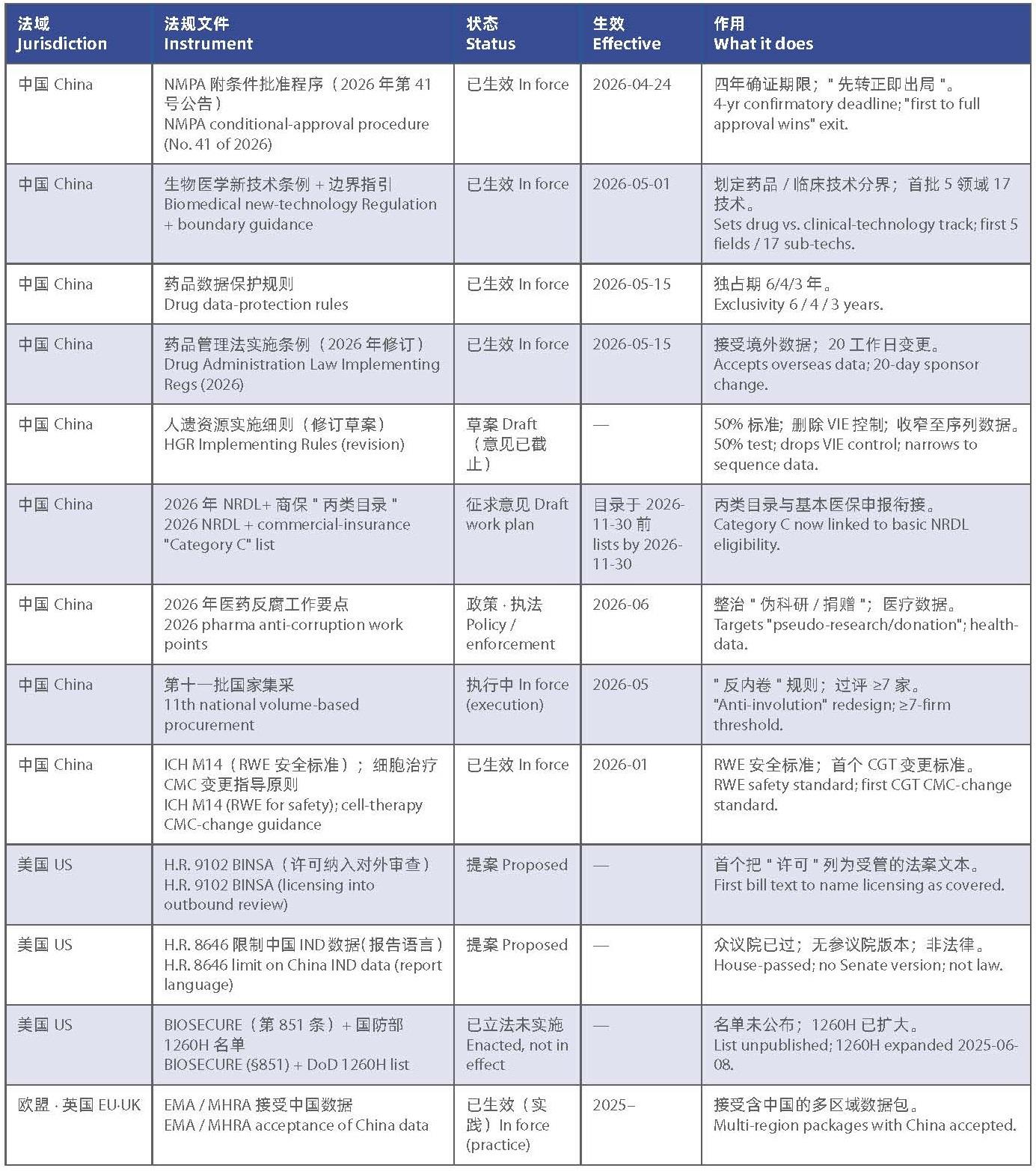
- The NMPA has overhauled its conditional-approval procedure. A conditionally approved drug must now finish its confirmatory studies within four years, and its registration certificate is tied to that deadline. The bigger change: once a same-class drug with the same target and indication wins full approval, the other conditionally approved products lose their status. Conditionally approved products also cannot serve as the reference drug for generics.
- Why it matters: Conditional approval is the main accelerated route to market for serious-disease drugs in China, so the new rules reach anyone planning a China registration. The four-year deadline reshapes development timelines, and the “first to full approval wins” exit makes being first a competitive necessity rather than a filing detail — a holder can lose its conditional status if a same-target, same-indication competitor confirms first. That feeds regulatory and launch planning, competitive positioning, and asset valuation; in a transaction, it also belongs in diligence and development covenants.
- Status: In force — China — State Council Regulation effective 2026-05-01; NHC boundary guidance 2026-05-01
- China now has its first State Council-level rules for biomedical new technologies, covering an initial five fields and seventeen sub-technologies — among them the closely-watched cell, gene and somatic-cell areas. The Regulation took effect on 1 May 2026, and an NHC package issued on 30 April draws the line between a “biomedical new technology” (regulated by the NHC as a clinical application) and a “drug or device” (regulated by the NMPA through registration). The Regulation also requires strict informed consent, bars charging trial subjects, and sets out liability for health damage and data/privacy protection.
- Why it matters: For anyone developing or commercializing cell, gene, or other novel-technology products in China — companies, hospitals, and research institutions alike — this settles a threshold question: are you on the drug track (NMPA registration) or the clinical-technology track (NHC approval)? The answer drives your approval pathway, who may act as sponsor, and your clinical-conduct and data-compliance obligations (consent, no charging of subjects, liability, privacy). It also shapes how any collaboration, supply, or transfer in this space is structured.
- Status: In force — China — effective 2026-05-15
- On 15 May 2026, the NMPA’s drug data-protection rules took effect. They give tiered exclusivity — reported as six years for innovative (Category 1) drugs and first-launched overseas originators, four years for improved drugs, and three years for the first generic filer. During that window, the NMPA will not approve an improved, generic, or biosimilar drug that relies on the protected data without the holder’s consent. The same day, the 2026 revisions to the Implementing Regulations of the Drug Administration Law confirmed at regulation level — for the first time — that overseas clinical data may be used for China registration where the data complies with the NMPA’s applicable technical requirements; those technical standards continue to be set by the 2018 NMPA Technical Guidance on Accepting Overseas Clinical Trial Data (which broadly requires the data to be true, complete, accurate and traceable, to support efficacy and safety, to meet ICH-GCP and registration-inspection requirements, and to be free of ethnic-sensitivity factors affecting efficacy or safety). The revisions also set a 20-working-day review for sponsor changes.
- Why it matters: This cuts two ways for the market. For an originator, the China dossier now carries a defined exclusivity term — a real input to lifecycle and market-protection strategy and to an asset’s value. For a generic or biosimilar developer, it is a timing-and-consent constraint on relying on protected data. And accepting overseas clinical data speeds China registration for anyone bringing in an ex-China product. Confirm the current version of the controlling text before any China-law analysis.
- Status: Draft for comment — China — issued 2026-05-08, comment closed 2026-06-07
- China’s draft 2026 Implementing Rules for human genetic resources (out for comment) would ease several sore points. The “foreign party” test would turn on a 50% equity or voting threshold and drop the old “actual control” concept that caught VIE structures. “HGR information” would narrow toward genetic sequence data, expressly leaving out plain clinical, imaging, protein and metabolic data. And a fast-track filing would be added for collaborations that do not export HGR information. None of this is law yet. The rules in force are still the 2024-amended HGR Regulations and the Implementing Rules from 1 July 2023 — and Chinese drafts often tighten between comment and final.
- Why it matters: HGR rules reach any activity that touches Chinese human genetic samples or data — clinical trials, academic and industry collaborations, CRO arrangements, and cross-border data flows — so the easing, if finalized, would broadly cut friction for international R&D. Until then, treat HGR approval/filing as a live compliance gate on those activities. Plan to the current rules; where data moves under a contract, let the transfer turn on the final text rather than the draft.
- Status: Draft for comment — China — NHSA 2026 work plan issued 2026-05-09; comments closed 2026-05-15; lists due by 2026-11-30
- The NHSA has opened the 2026 cycle for the National Reimbursement Drug List (NRDL) and, in its second year, the commercial-insurance innovative-drug list — the “Category C” list. For the first time, being on the 2025 Category C list is one of the qualifying conditions to apply for the basic NRDL, formally linking the two. The cycle also opens to drugs that converted from conditional to full approval in 2023–2026. This remains a draft work plan; the final lists are due by 30 November 2026.
- Why it matters: Reimbursement is the commercial value driver for an innovative drug in China, so the 2026 cycle bears on any manufacturer’s pricing, launch, and revenue planning — and on the models investors run on those assets. The new link makes the commercial-insurance Category C list a staging lane toward the basic NRDL. Treat it as part of access strategy, and note it is still a draft plan, with final lists due by 30 November.
- Status: Policy / enforcement priority (non-binding) — China — NHC + 13 departments, June 2026
- Fourteen departments led by the NHC have set the 2026 priorities for cleaning up improper conduct in drug procurement and medical services, deepening the centralized anti-corruption campaign. New this year: a focus on disguised kickbacks dressed up as “research” or “donations” (“pseudo-research, pseudo-donation”), and on health-data management. These are annual work points — enforcement-directing policy, not binding law.
- Why it matters: This is a live compliance and enforcement risk for any company with commercial operations or HCP interactions in China. The reach into “pseudo-research” and “pseudo-donation” channels goes directly to how medical affairs, investigator-sponsored studies, grants, donations, and speaker or consulting arrangements are run — so it bears on internal controls, monitoring, and exposure regardless of any deal. Where a transaction is involved, it raises the bar on a partner’s promotional practices and supports tighter anti-bribery reps, audit rights, and termination triggers.
- Status: Proposed (introduced, not law) — United States — introduced 2026-06-02
- The effort to bring private out-licensing under US outbound-investment review has moved from a letter to actual bill text. The Biotech Investment National Security Act of 2026 (H.R. 9102) would add “biotechnology” to the outbound-investment rules (the COINS framework) and — reportedly for the first time in a federal bill — treat “licensing a prohibited technology from a covered foreign person” as a covered activity. It directs Treasury to give “particular consideration” to deals that license IP or drug-discovery platforms, with effect one year after enactment. As of today, no US regime appears to reach a straight outbound license: CFIUS covers inbound M&A, and the outbound rule covers equity. This bill is the attempt to close that gap — but it has only been introduced and referred to committee, with no markup and no Senate version.
- Why it matters: This bears on any US or multinational company that invests in or licenses from Chinese biotech, and on how cross-border structures are planned — not only on a deal in progress. There is no need to price in an approval step that does not yet exist; but where new China-facing arrangements are being built, a clear “change-in-law” mechanic now (who notifies, who bears the filing burden, what happens to unpaid milestones if outbound review later reaches licensing) is comparatively cheap insurance. The exposure sits with the US or multinational side and any US NewCo or SPV.
- Status: Proposed (US) / In force (EU·UK)
- In the US, the House passed the FY2027 Agriculture-FDA spending bill (H.R. 8646) on 4 June 2026, 213-210. The language that would tell the FDA not to “accept, review or consider” clinical data from sites in China (and Iran, North Korea, Russia) for an IND sits in the committee report rather than the bill’s text — so it is not binding even now, and the Senate has not taken up its own version, leaving nothing to reconcile. Meanwhile, the EU and the UK have continued to accept China data as part of multi-region trials: serplulimab won first-line approval for extensive-stage small-cell lung cancer in both, on the strength of the global ASTRUM-005 trial, and the MHRA’s chief executive has described the agency as part of an “international ecosystem” of reliance. An open question is whether EU/UK acceptance extends to data from China alone, rather than only multi-region trials that also have non-China arms.
- Why it matters: This shapes global development and regulatory strategy for anyone running or relying on China-generated clinical data — trial design, registration sequencing, and where value can be realized — not only how a deal allocates risk. Treat the US measure as a specific, foreseeable change-in-law tied to FDA data acceptance, not an on/off switch; and design trials and territory strategy so EU/UK (and other ICH) value holds if the US route narrows.
- In China: Volume-based procurement, round 11. The NHSA’s 11th national VBP round is in execution (notice dated 22 May 2026), the first under redesigned “anti-involution” rules — an anchor price, a revival mechanism, brand-level volume reporting, and a floor of seven qualified firms. It signals a move away from pure lowest-price competition and may moderately reshape post-patent economics. Technical guidance. The NMPA adopted ICH M14 (real-world evidence for drug-safety assessment; Announcement No. 16 of 2026), and the CDE issued trial guidance on CMC changes for cell-therapy products (Announcement No. 13 of 2026) — the first whole-lifecycle standard for CAR-T, TIL and stem-cell manufacturing changes. Both bear on pharmacovigilance obligations and CMC/change-control practice.
- In the US / internationally: BIOSECURE. §851 is law but not yet in effect — no covered-entity list, no procurement-rule amendment, a five-year grace period for pre-existing contracts; the Pentagon’s 1260H list grew on 8 June 2025 (adding Novogene and WuXi AppTec), and a 1260H listing will automatically make a company “of concern” once BIOSECURE goes live. It is a procurement law rather than a deal-blocker, and reaches private parties only through the performance of US-government contracts. Export controls — nothing new. US BIS controls on certain biotech equipment (ECCN 3A069/3E069, in force since January 2025) presume denial to China; China’s 2026 dual-use and 2023 catalogues target human germline editing and cloning. Both bear on whether equipment or methods can be moved across borders.
Feature Four US national-security tools that can touch an outbound license — at a glance
A company with China-facing biotech relationships now faces four separate US national-security tools, and each reaches a different part of the picture. CFIUS reviews money coming in — investments in and acquisitions of US businesses — not licenses going out. The outbound-investment rule (COINS/OISP) reaches equity going out into certain Chinese tech sectors, but it leaves biotech out, at least for now. BIOSECURE reaches federal procurement; it touches private parties only through the performance of US-government contracts, and is not yet live. And H.R. 9102 (BINSA) is the proposed fourth piece — the one that, uniquely, names licensing itself: its text would add “licensing a prohibited technology from a covered foreign person” to outbound review.
The practical takeaway: as of today, no US regime appears to reach a straight outbound license, and the instrument most likely to change that is the bill now in text. So the sensible hedge — for any company building or holding China-facing biotech relationships — is not a clearance condition for a gate that does not yet exist, but a clear “change-in-law” mechanic in the agreement now: define the trigger; say who carries the filing and cooperation burden if outbound review is later extended to licensing; and spell out what happens to unpaid milestones if a future filing is blocked or conditioned. One structural point is worth flagging: the same equity link that defines an ex-China “NewCo” is also what a future outbound review would be most likely to catch, so the choice of structure is itself a choice about who bears the regulatory risk.
- Revisit China regulatory and launch strategy for accelerated-pathway assets — the four-year confirmatory deadline and the competitor-exit rule make being first a competitive issue, not just a filing detail.
- For cell, gene, or other novel technologies, classify the product first — drug track or biomedical-new-technology track — before committing to a development, clinical, or partnering plan.
- Fold the in-force data-protection exclusivity and the 2026 reimbursement (NRDL / Category C) track into pricing, market-access, and lifecycle planning; investors should reflect both in asset models.
- Pressure-test China compliance now — medical affairs, grants, donations, and HCP engagement — against the “pseudo-research / pseudo-donation” enforcement focus, independent of any transaction.
- Treat HGR approval/filing as a live gate on any work touching Chinese samples or genetic data; plan to the current rules while watching the draft.
- On US-facing matters, track the China-data measure as a foreseeable change-in-law and keep ex-US (EU / UK / ICH) options open; for cross-border biotech structures, consider an outbound-investment change-in-law mechanic ahead of H.R. 9102 and screen counterparties for BIOSECURE / 1260H exposure.